In the mid-nineteenth century, a reform movement reshaped Thai monastic life. Prince Mongkut — who spent twenty-seven years as a monk before ascending the throne as Rama IV — had observed from the inside the gap that had opened between what the Vinaya prescribed and what monastic custom had become. The order he founded, the Dhammayut, called for stricter observance of the monastic code, more careful study of the Pāli Canon, and a return to the texts rather than to local habit.
The reform did much to restore discipline and learning. What no reform can produce by decree, however, is inner attainment. By the late nineteenth century, much of Thai Buddhism had become a religion of study and ceremony. Meditation had drifted into the background, and the actual work the texts described — sitting down and developing samādhi (concentration) to real depth — had in many quarters been replaced by the theoretical study of it.
It was into this gap that the Thai Forest Tradition stepped.
Ajahn Sao and the Roots of the Tradition
The tradition’s founding figure was Ajahn Sao Kantasīlo (1861–1941), born in Ubon Ratchathani in Thailand’s northeast — the region that would produce most of the tradition’s great teachers. As a monk of the Dhammayut order, he was defined not by institutional position but by practice. He was spare, austere, and almost silent as a teacher.
He took to the forests, kept the dhutaṅga (ascetic disciplines) the Vinaya permits, and lived close to the conditions the Buddha’s first monks had known: dwelling at the foot of trees, eating once a day from the alms bowl, wearing robes sewn from discarded cloth.
Ajahn Sao taught very little through words. He taught through what he had become, and through the direct guidance he gave to those who practised under him. The meditation object he most relied on, and passed to his students, was buddho— the mindful recollection of the Buddha held in a single repeated word. His teaching on using buddho, preserved through those who recorded it, is among the earliest direct records of the practice in this lineage. From its very root, then, the forest tradition and the buddho practice are inseparably bound together.
His most influential student was Ajahn Mun Bhūridatta.
Ajahn Mun and the Wandering Decades
If Ajahn Sao was the root, Ajahn Mun (1870–1949) was the force that carried the tradition across the whole region. Also born in Ubon Ratchathani, he took his early training under Ajahn Sao and then gave himself to decades of wandering and solitary practice. He moved through the forests and mountains of the northeast, into Laos, through central Thailand, and across the north, spending years in the hills around Chiang Mai. He sought out remote places precisely because they were difficult. The forest, for the forest monk, is not scenery but a teacher. It strips away comfort and distraction until the mind has nowhere left to hide.
Like his own teacher, Ajahn Mun made buddho central to his method. He had his students hold the word continuously, letting it occupy the mind until the mind gathered around it and grew still. His biography, recorded by his disciple Ajahn Mahā Boowa, describes this practice plainly: the word carried through every posture and every hour, the concentration deepening, the hindrances falling away. The practice was not gentle. It was demanding, sustained, and uncompromising — and it produced results that kept drawing serious practitioners to him for the rest of his life.
His teaching was exacting in the way that only honest teaching is. He could see, with a clarity students often found unsettling, where each of them stood and what was obstructing them, and he accepted nothing less than complete dedication to the practice itself. Sīla (morality) had to be spotless. Samādhi had to be genuinely developed, not merely understood. Wisdom would then follow of its own accord. Any shortcut at any stage meant building on an unstable foundation, and Ajahn Mun was merciless towards those.
The monks he trained are much of what is alive in Thai forest practice today — among them Ajahn Thate, Ajahn Lee, and Ajahn Mahā Boowa. Each became a significant teacher in turn, and each carried something of what he had received.
Buddho Through the Generations
The meditation word buddho, often called a mantra, was never the only object practised in the forest. Ajahn Mun and his disciples also worked with mindfulness of breathing, with the contemplation of the parts of the body, and with the recollection of death. But buddho held a central and recurring place, and several of the tradition’s teachers wrote about it directly.
Among them was Ajahn Thate, a senior disciple of Ajahn Mun who taught meditation from long personal practice. His account of buddho practice sets the method out step by step: repeat buddho, buddho, buddho, and use mindfulness to keep the mind with the word until it can rest there steadily. As concentration deepens, he explains, the repetition eventually falls away of its own accord, leaving only the awareness that had been saying it — and that awareness becomes the object.
Most of what he writes, though, concerns the mind’s resistance. The moment you try to settle it on buddho, it runs off — to unfinished work, to family, to old pleasures, to every kind of fear — and his counsel is simply to bring it back, again and again, without hurry. He likens it to a farmer growing rice: you cannot skip the steps, and you cannot pull on the plants to make them ripen faster. Above all he warns against wanting results. “Desire,” he writes, “is the most serious obstacle to the concentrated mind.” And he is clear about where the whole effort leads. Concentration is the foundation without which wisdom has no strength; insight is not something you can assemble by thinking about it, but something that arises from concentration once concentration is firm.
What gives the word its particular weight is what it points to. Buddho is a form of buddhānussati (recollection of the Buddha), and it holds the qualities of an awakened mind as its content. To meditate on buddho is not to concentrate on a neutral support, the way one might rest attention on a coloured disc or the breath. The word refers, at every repetition, to the Buddha’s purity, wisdom, and freedom. As concentration deepens and the mind draws closer to its object, the connection to those qualities deepens with it. The forest teachers understood this. The word was not merely a device for stilling the mind; it was a relationship with the very qualities the practice is meant to develop.
Ajahn Chah and the Opening to the World
Of the teachers this tradition produced, Ajahn Chah (1918–1992) was the one who took it furthest into the world — and did so without thinning what made it worth encountering. His own meeting with Ajahn Mun was brief, a matter of a few days, but it was decisive in resolving the doubts that had dogged his practice and in setting his course. Notably, he belonged to the Mahānikāya, the larger of Thailand’s two monastic orders, rather than to the Dhammayut of Ajahn Sao and Ajahn Mun. The forest tradition, in other words, never belonged to a single nikāya (ordination order). What held it together was practice, not affiliation.
Ajahn Chah had a rare capacity to take the rigour of forest practice and make it accessible without simplifying the path itself. He found language and examples that lay people, young monks, and Westerners with no deep background in the Buddhist scriptures could genuinely receive. His monastery, Wat Nong Pah Pong, became a true centre of practice, and its branch monastery Wat Pah Nanachat was established specifically to train Western monastics. Through his Western students — Ajahn Sumedho among the first — the tradition reached North America, Australia, Britain, and continental Europe.
Ajahn Chah also modelled something beyond his teaching method: the readiness to recognise genuine attainment wherever it appeared, regardless of lineage or label. The Dhamma was what mattered, and its presence could be acknowledged across any institutional line. The monks who carry his tradition forward have kept that quality, and it bears directly on the recognition Ahba has received from them.
A Teacher Among Masters
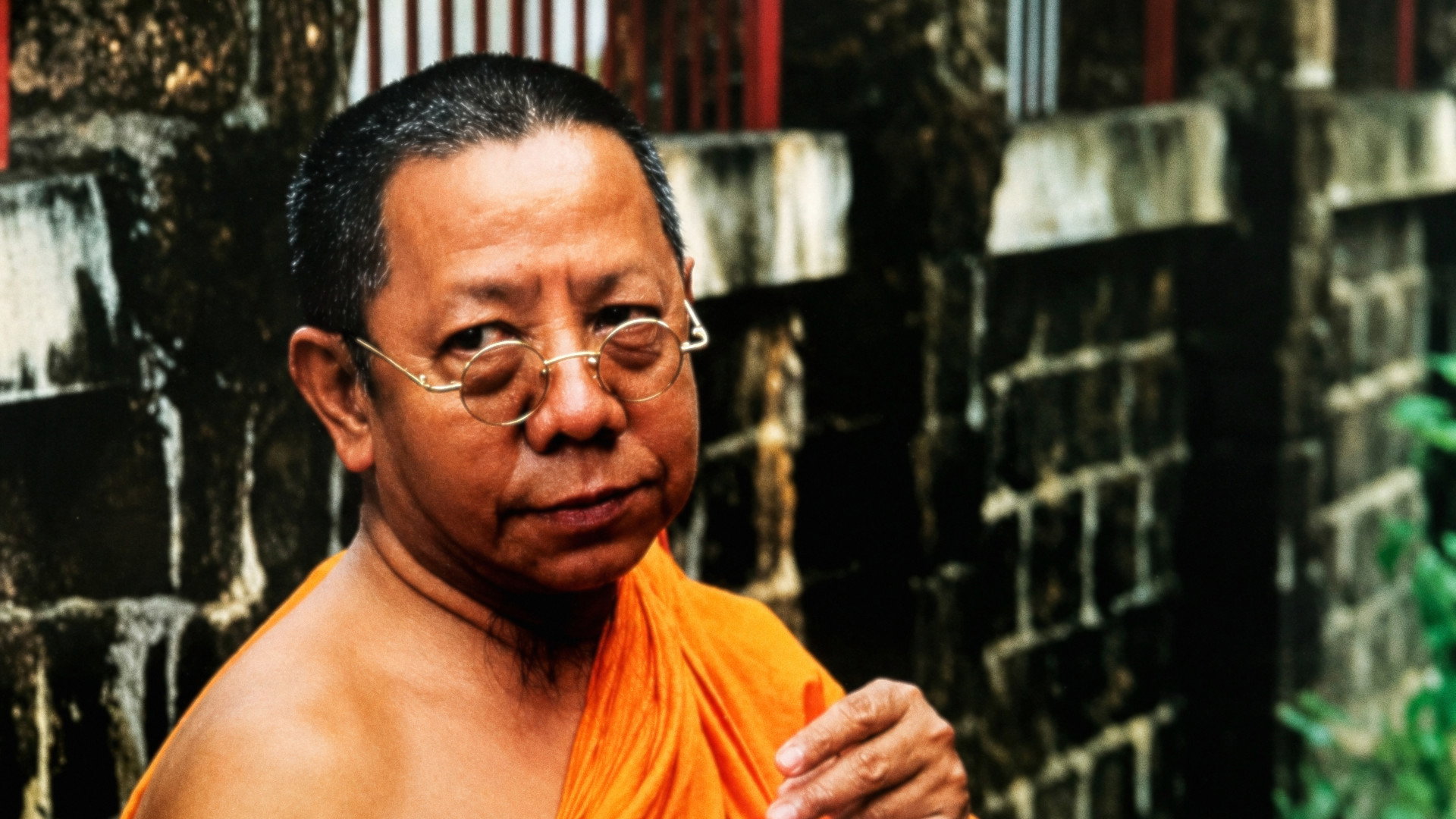
Ahba — Luang Por Opart — comes from a parallel and deeply related stream. He is Burmese, and his training as a meditator took place in Myanmar rather than in the Thai lineages. His practice is samatha (calm, concentration meditation), built on the same conviction that runs through the forest tradition: that genuine concentration must be developed before insight can follow, and that the depth of the foundation determines the stability of everything raised upon it. The buddho practice taught on this site comes through Ahba, and it rests on the same essentials the forest teachers relied on. He has sometimes indicated that through this practice alone, if pursued with sufficient patience and effort, a practitioner could reach the safe harbour of Nibbāna (Nirvana) without needing to change to another object.
Ahba fled Myanmar in the 1980s. After walking hundreds of kilometres through the Thai jungle, he settled as abbot of a small wooden monastery in the countryside of northern Thailand, which has since grown into one of the largest in the region. His monastic school, where the monks study the language of the ancient texts, has for years topped the national Pāli examinations, earning him a royal award. In the light of his actual standing, however, the awards are beside the point.
That standing shows most clearly in the respect of other accomplished practitioners — something reputation alone cannot manufacture, and something that meditators whose own minds have been developed to real depth recognise at once. Monks travel from across the country to pay homage and to seek his guidance on their practice, among them respected meditation teachers and monks reputed to be arahants. Monks of the Ajahn Chah tradition visit him regularly, not merely to pay their respects but to receive teachings on meditation. These are monastics from one of the most serious lineages in the contemporary Theravāda world, and their deference is not lightly given. Phra Khrūbā Boonchum — among the most revered ascetic monks of the wider Mekong region, held in the highest regard by Thai, Shan, and Burmese alike — has himself come to see Ahba.
The community around Ahba reflects the same indifference to nikāya boundaries that has always marked the forest tradition. The monastery houses monks who keep the strict dhutaṅga ascetic disciplines alongside monks of the Mahānikāya who follow the standard monastic discipline. Both practise under the same teacher, and both receive the same clear instruction. Both are helped forward from exactly where they stand.
A Living Tradition
What runs through this whole lineage — from Ajahn Sao sitting silent in a northeastern forest, through Ajahn Mun’s wandering decades, through the teachers he trained and the tradition Ajahn Chah took to the West — is a single insistence: the path must be walked, not described. The texts are taken seriously. The history is real and worth knowing. But neither purifies a mind.
Theravāda Buddhism at its foundation is a practice tradition, and the gradual path it teaches is not an arrangement of concepts but a description of how a human mind is actually transformed: sīla as the ground without which samādhicannot take root, samādhi as the heart of the work, and paññā (wisdom) arising naturally in a mind made clear and pure. The forest tradition has carried that forward for more than a century, generation by generation, through practitioners who sat down and did the work.
That work continues. In a forest monastery in northern Thailand, the ascetic monks keep to the trees and the alms bowl, the Mahānikāya monks keep to the hall, and visitors arrive from across the Buddhist world to learn. Ahba still lives in the same wooden kuṭi (hut) he has always lived in. And at some point, as on every day for well over a century, someone closes their eyes and keeps the mind with the Buddha — repeating the same word Ajahn Sao gave to Ajahn Mun, listening to the sound, and letting the sound carry the mind home.
Do you want to start meditating or deepen your practice?
We offer personal guidance, completely on a donation basis.
You yourselves must strive, the Buddhas only point the way
Buddha, Dhp 276

The Jhanas in Theravada Buddhist Meditation
Bhante Henepola GunaratanaThis work provides an analytical study of the jhānas, an important set of meditative attainments in the contemplative discipline of Theravāda Buddhism.

Meditation on Buddho
Ajahn ThateWhen you go to study meditation with any group or teacher who is experienced in a particular form of meditation, you should first make your heart confident that…

Ajahn Sao’s Teaching on Meditation
Ajahn SaoIn our day and age, the practice of going into the forest to meditate and follow the ascetic dhutanga practices began with Phra Ajahn Sao Kantasilo…

Buddha Statues: History, Use & Meaning
The EditorsWhen did the use of statues in Buddhism begin? What did the Buddha himself advise on their use? And wat do the various Buddha statues mean? In this text we…

Samaññaphala Sutta: The Fruits of the Contemplative Life
Thānissaro BhikkhuThis discourse is one of the masterpieces of the Pali canon. At heart, it is a comprehensive portrait of the Buddhist path of training…

Thoughts on the Dhamma
Mahasi SayadawWhile the present book was in preparation, its author, the Venerable Mahasi Sayadaw of Burma, passed away at the age of 78. Thus, unexpectedly — as death so…